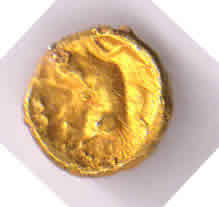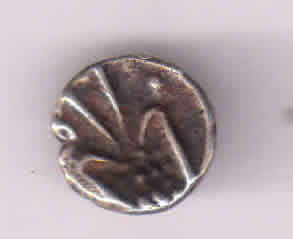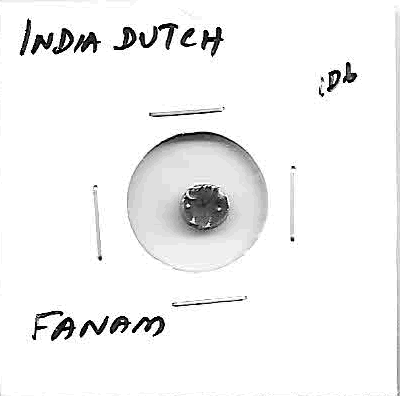
Vijaya Nagar – Bele 12 different 14 th – 17th century , 0.034 mg gold coins ( World’s smallest gold coin)

World’s smallest gold coin😍

The bele🔥

It was the last great Hindu kingdom in India, acting as a bulwark against the expanding tide of Islamic and late Mughal power in the north. Noted for its opulent temples, its coinage reflected its great wealth. The bele is notable for being worlds the smallest gold coin denomination.

World’s Smallest GOLD Coin (Bele) From India Vijayanagara Empire (1336 -1646 CE)

Shilaharas of Karad (12 Century AD), Wai-Karhad Region, gold coin K1

The Shilaharas of Karad, a branch of the Shilahara dynasty, ruled the Wai-Karhad region of India (present-day Maharashtra) from the 10th to the 13th centuries AD, with their capital likely at Karad during the reign of Jatiga II.  

The Shilaharas of Karad, a branch of the Shilahara dynasty, ruled the Wai-Karhad region of India (present-day Maharashtra) from the 10th to the 13th centuries AD, with their capital likely at Karad during the reign of Jatiga II. 

Here’s a more detailed look:
  • Shilahara Dynasty:

    The Shilaharas were a prominent regional power in western India, with their rule spanning from the 8th to the 13th centuries AD. 

  • Origin:

    They initially served as feudatories of the Rashtrakutas, but later established their own independent rule. 

  • Branches:

    The Shilahara dynasty divided into three main branches, including the Northern Konkan Shilaharas and the Shilaharas of Karad. 

  • Karad Branch:

    The Shilaharas of Karad, also known as the Wai-Karhad Shilaharas, ruled over the Wai-Karhad region, with Karad as their likely capital. 

  • Key Rulers:

    Key rulers of the Shilaharas of Karad include Jatiga II, Gonka, and Bhoja II. 

  • Geographical Control:

    The Shilaharas of Kolhapur, a branch of the Shilaharas, ruled over Satara and Belagavi districts from 1000 to 1215 AD. 

  • Gonka’s Significance:

    Gonka is described as the Lord of Karhad (Karad), Mairifvja (Miraj) and Konkan. 

  • Dynasty’s End:
    The Shilahara dynasty’s last ruler was Bhoja II, who ruled from 1175 to 1212 CE.